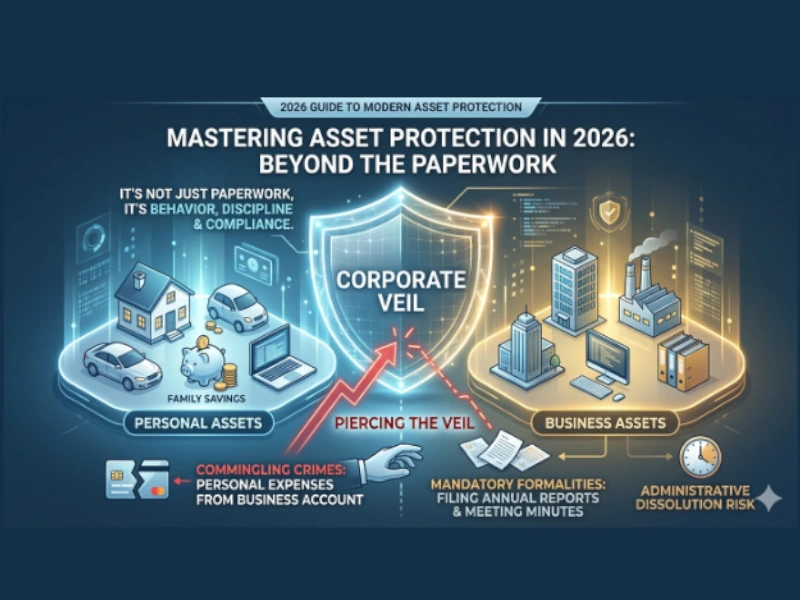
In 2026, protecting your assets isn’t just about starting an LLC and hoping it works. Now, courts, creditors, and regulators look at more than just papers.
They look at how people act, how well they stick to their budgets, and how well they follow the rules. The truth is easy to understand: your behaviors and structure are the only things that can keep you safe.
This guide breaks down how modern asset protection works, why most business owners lose it, and what you must do to keep your liability shield intact.
The Anatomy of the Corporate Veil
The corporate veil is the legal boundary that separates your personal assets from your business liabilities.
When properly maintained, it protects your home, savings, and personal property from business lawsuits and debts.
Legal Separation Between the Owner and the Entity
The foundation of asset protection is separation. Your LLC must operate as a distinct legal person.
Key elements of separation include:
- Separate business bank accounts
- Distinct accounting records
- Business-only financial transactions
- Proper contracts signed in the company’s name
- Clear documentation of ownership and roles
Why it matters:
If courts see no real separation, they may treat the business as your “alter ego,” eliminating protection entirely.
Why Federal Courts Respect the LLC Structure
As long as they are used properly, federal and state courts usually respect LLCs because they are meant to limit liability.
The company veil is usually upheld by courts when:
- The LLC is properly formed and registered
- Owners follow internal formalities
- Finances are not mixed
- The company is adequately capitalized
- Fraud or misconduct is not involved
LLC vs Sole Proprietorship Protection (Comparison Table)
This table only shows the basics. Before making a final choice about how to set up your business, you should learn about all the legal and tax effects of choosing between an [LLC vs Sole Proprietorship].
| Feature | LLC | Sole Proprietorship |
| Personal liability protection | Yes | No |
| Separate legal entity | Yes | No |
| Court recognition of separation | Strong (if maintained) | None |
| Asset seizure risk | Limited | High |
| Tax flexibility | High | Low |
(Secret): Commingling Crimes: The #1 Reason Small Business Owners Lose Protection
Even a perfectly formed LLC can collapse in court if you mix personal and business finances. This is called commingling, and it is the fastest way to “pierce the corporate veil.”
The Dangers of Using Business Funds for Personal Expenses
Using business money like your personal wallet is one of the most damaging mistakes an owner can make.
Common commingling mistakes include the following:
- Paying rent or groceries from business accounts
- Depositing personal income into the LLC account
- Using company funds for vacations or luxury purchases
- Not tracking owner draws properly
- Mixing bookkeeping records
Legal consequences can include:
- Loss of liability protection
- Personal asset exposure in lawsuits
- Tax penalties and audits
- Court-ordered veil piercing
Commingling Risk Impact Table
| Behavior | Risk Level | Potential Outcome |
| Occasional minor mixing | Medium | Tax scrutiny |
| Regular personal spending | High | Veil piercing risk |
| No bookkeeping separation | Very High | Full liability exposure |
Why Shared Credit Cards Can Pierce Your Corporate Veil
Using one credit card for both business and personal use is one of the most common and dangerous mistakes.
Courts view this as:
- Lack of financial discipline
- Failure to maintain separation
- Evidence of alter ego behavior
To maintain protection, you must ensure the following:
- Business credit cards are strictly business-only
- Personal cards are never used for company expenses
- Expense tracking is documented and categorized
- Receipts are properly stored for audits
Bottom line: If money flows freely without structure, liability protection collapses just as easily.
Mandatory Formalities for LLC Compliance
Many business owners assume LLCs have “no rules.” In reality, compliance formalities are what keep your liability shield intact.
Even single-member LLCs must maintain basic legal discipline.
Filing Annual Reports and Statements of Information
Most jurisdictions require periodic filings to keep your LLC active and recognized.
Core requirements typically include:
- Annual or biennial reports
- Updated business addresses
- Confirmation of ownership structure
- Registered agent maintenance
- State filing fees
LLC Compliance Checklist
- Annual report filed on time
- Registered agent updated
- Business address current
- Tax filings completed
- Operating agreement reviewed
- Financial records were matched up.
Not following the rules can lead to:
- Administratively ending the LLC
- Not being protected by the law
- Fines and fees for getting back on track
- Difficulty defending lawsuits
Keeping Meeting Minutes Even as a Single-Member LLC
Even if you are the only owner, maintaining records of decisions strengthens your legal protection.
Meeting minutes help prove:
- The LLC is actively operated as a separate entity
- Decisions are made in a business capacity
- The company is not an “extension” of personal identity
What Should Be Documented
- Major financial decisions (loans, purchases, investments)
- Changes in business strategy
- Approval of contracts or agreements
- Tax elections or structural changes
- Asset purchases or disposals
Simple Record Structure Table
| Document Type | Purpose | Frequency |
| Meeting minutes | Legal proof of decisions | Monthly/Quarterly |
| Operating agreement updates | Structural clarity | As needed |
| Financial resolutions | Transaction approval | Ongoing |
| Annual report | State compliance | Yearly |
Conclusion
Protection of assets in 2026 is not about being complicated; it is about being consistent. If you act like you have an LLC, the courts will also look at whether you have formed one.
Your company veil stays strong as long as you keep things separate, don’t mix, and follow basic compliance rules. If you don’t pay attention to them, even the strongest building can fall apart when the law looks at it.
Not papers, but discipline makes the difference between safety and risk.
FAQS
What does “Piercing the Corporate Veil” mean?
It’s when a court doesn’t care about the legal separation of your LLC and holds you directly responsible for business debts or lawsuits. This generally happens because of fraud, mixing funds, or not following the rules for an LLC.
How often should I update my LLC records?
You should update your LLC records regularly, ideally whenever any major business change happens, and at least once a year during your annual review. This includes finances, ownership details, and compliance filings.
Can BusinessRocket help me stay compliant with state filings?
Yes, services like BusinessRocket can help manage filings such as annual reports, registered agent updates, and other state compliance requirements. This helps reduce the risk of missing deadlines or losing your LLC status.